
HOTLINE: +91 851-114-2701
1 listings from verified sellers across India
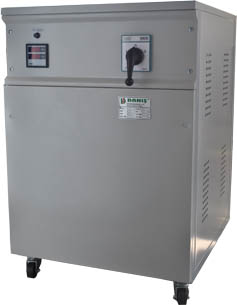
Servo Voltage Stabilizer
A servo voltage stabilizer is an automatic voltage regulator that provides a constant output voltage regardless of fluctuations in the input AC mains supply. It achieves this by using a servo motor to drive an auto-transformer, thereby continuously adjusting the voltage to maintain a stable output. This protects connected equipment from voltage sags, surges, and brownouts.
Types of Servo Voltage Stabilizer
Single-Phase Stabilizers:
For single-phase power supplies, common in residential, office, and small industrial settings.
Three-Phase Stabilizers:
For three-phase power supplies, essential for industrial machinery, large commercial buildings, and factories.
Balanced Output Type: Provides equal voltage stabilization across all three phases.
Unbalanced Output Type: Can stabilize each phase independently, crucial when loads are unevenly distributed across phases.
Air-Cooled Stabilizers:
Use natural convection or forced air cooling, common for most applications.
Oil-Cooled Stabilizers:
Immersed in transformer oil for superior cooling, used for very high capacities or in dusty/harsh environments.
Indoor/Outdoor Models:
Designed for specific installation environments.
Applications in Various Industries
Manufacturing: Protecting sensitive machinery like CNC machines, robotics, laser cutting equipment, injection molding machines from voltage fluctuations.
Medical & Healthcare: Ensuring stable power for MRI machines, X-ray equipment, diagnostic tools, and life-support systems.
IT & Data Centers: Protecting servers, networking equipment, and sensitive electronics from power quality issues.
Telecommunications: Stabilizing power for base stations, switching equipment.
Textile Industry: Ensuring consistent power for looms, dyeing machines, and other process equipment.
Printing & Packaging: Protecting high-speed printing presses and packaging lines.
Residential & Commercial: Protecting expensive appliances, air conditioners, and sensitive electronics.
Technology:
The core technology involves:
Buck/Boost Transformer: To add or subtract voltage.
Variac (Auto-transformer): A continuously variable transformer.
Servo Motor: Drives the variac's carbon brush to adjust the voltage.
Control Circuit: A microcontroller or a dedicated PCB constantly senses the output voltage and sends signals to the servo motor to correct deviations.
Feedback Loop: Ensures precise and continuous voltage regulation.
Protection Features: Overload protection, short circuit protection, over/under voltage cut-off, time delay.
Material Selection Considerations