
HOTLINE: +91 851-114-2701
1 listings from verified sellers across India
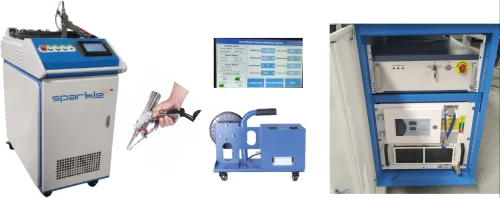
Fiber Laser Marking Machine
A fiber laser marking machine uses a fiber optic cable as the gain medium and a laser diode as the pump source. This type of laser produces a high-quality, high-speed, and precise beam that can mark various materials with permanent, high-contrast marks. They are known for their efficiency, long lifespan, and minimal maintenance.
Types of Fiber Laser Marking Machine
Desktop Fiber Laser Markers: Compact units suitable for small workshops or labs.
Portable Fiber Laser Markers: Designed for on-site marking, lighter and easier to move.
Integrated Fiber Laser Markers: Systems designed to be integrated into production lines for automated marking.
Galvo Fiber Laser Markers: Utilize galvanometer mirrors for high-speed beam steering, common for most marking applications.
MOPA Fiber Laser Markers: (Master Oscillator Power Amplifier) Offer pulse width adjustability, allowing for more control over marking characteristics like color marking on certain metals or cleaner annealing.
Applications in Various Industries
Manufacturing: Product identification, serial numbers, date codes, barcodes, QR codes on metal and plastic parts (e.g., automotive components, electronics, tools).
Jewelry: Engraving intricate designs, logos, and personalization on precious metals.
Medical Devices: Marking surgical instruments, implants, and other devices with UDI (Unique Device Identification) for traceability.
Electronics: Marking PCBs, integrated circuits, and connectors.
Aerospace: Part identification and traceability on critical components.
Packaging: Marking various packaging materials, although CO2 lasers are often preferred for organic materials.
Technology:
Utilizes an active fiber gain medium doped with rare-earth elements (like Ytterbium). The laser diode pumps the fiber, exciting the dopants to produce photons. The light is then collimated and directed by a galvanometer scanning head for precise marking. Software control allows for complex patterns and data integration.
Material Selection Considerations
Everything you need to know about fiber laser marking machine
Fiber Laser Marking Machine light is created by banks of diodes. The light is channeled and amplified through fiber optic cable similar to that used for data transfer. The amplified light, on exiting the fiber cable, is collimated or straightened and then focused by a lens onto the material to be cut.
Fiber Laser Marking Machine is a permanent process that uses a beam of concentrated light to create a lasting mark on a surface.