AAC Block Manufacturing Machine
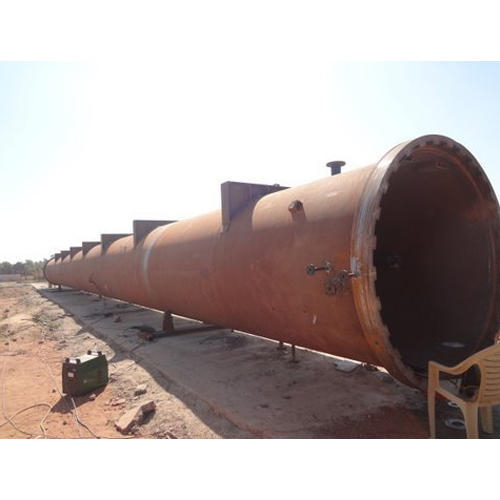
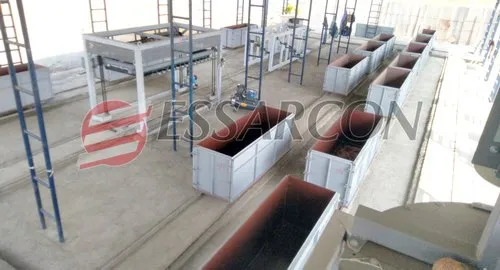
An Autoclaved Aerated Concrete (AAC) block making machine is an industrial production line that converts raw materials (sand or fly ash, cement, lime, gypsum, water and an expanding agent such as aluminium powder) into lightweight, thermally efficient AAC blocks or panels. The complete plant typically includes raw-material handling and batching, mixing and foaming systems, moulding tables or continuous conveyors (for green cake), steam autoclaves for curing, cutting machines (wire or band), palletisers or separators, and accessory equipment (mixers, crushers, conveyors, control systems). Modern lines range from small modular units for local supply to fully automated, high-capacity plants that supply regional markets.
Product types & specifications
- Small / modular units: lower capital cost, manual or semi-automatic handling, suitable for small towns and builders.
- Medium capacity lines: semi-automatic batching, mechanized cutting and autoclave systems; serve local/regional demand.
- High-capacity fully automatic plants: continuous or large batch mixers, automatic pouring, servo controlled cutting, automated palletising and centralised autoclaves for large industrial producers.
By cutting & pallet system
- Wire cutting plants: traditional method for blocks and panels; accurate and widely used.
- Band cutting / saw systems: used for particular profiles or large panels.
- Pallet-based vs pallet-free lines: pallet-based systems use pallets for moulding and curing; pallet-free (or foam casting with conveyor systems) reduce handling and can improve throughput on some designs.
By curing/autoclave type
- Batch autoclaves: common for small and medium plants.
- Continuous autoclaves or multi-chamber systems: used in high-throughput factories to keep autoclaving cycle time low and energy efficiency high.
Common technical specs customers evaluate
- Daily production capacity (m³/day or blocks/day) — ranges from a few tens to several thousand m³/day.
- Block densities (typically 400–900 kg/m³ depending on thermal/structural grade).
- Cutting precision (tolerance in mm), automation level (PLC/servo control) and required floor footprint.
- Energy consumption (especially steam and electricity) and water recycling features for operating cost benchmarks.
Applications & use cases
- Residential and commercial masonry (load-bearing and non-load bearing).
- Prefab construction and panel production for modular buildings.
- Industrial buildings requiring fire resistance and thermal insulation.
- Infrastructure projects that benefit from reduced dead load (multi-storey frames).
Common usage scenarios
- Developers and contractors using AAC blocks for faster wall construction and lower dead loads.
- Manufacturers supplying builders’ merchants, OCI (off-site construction integrators) and precast panel producers.
- Retrofit and energy-efficient construction where thermal insulation and indoor comfort are priorities.
Benefits and efficiencies
- Material efficiency: AAC blocks are lighter (lower transport and handling cost) and often require less mortar.
- Thermal & acoustic performance: reduces HVAC load and improves occupant comfort.
- Speed of construction: larger modular block sizes and straight edges speed masonry.
- Sustainability: many AAC plants use industrial by-products (fly ash), have lower embodied energy per m³ than fired clay bricks, and modern plants include recycling for process water and offcuts. These benefits make AAC attractive in green building programs.
Manufacturing & industry data
In India, Western states (Maharashtra and Gujarat) and major urban centres such as Mumbai, Pune, Surat and Ahmedabad are significant production and consumption centres for AAC blocks — West India has been reported as a leading producer/consumer region. Other hubs include Delhi-NCR, Tamil Nadu and Karnataka where both production equipment suppliers and end-users cluster. Trade directories also show active suppliers and dealers in Delhi, Hyderabad, Pune, Jaipur, Bengaluru, Kolkata, Mumbai and Coimbatore.
Popular Search
AAC Block Manufacturing Machine | AAC Block Manufacturing Machine For Sale | Buy AAC Block Manufacturing Machine | Brick AAC Block Manufacturing Machine | Concrete Block AAC Manufacturing Machine | Small AAC Block Manufacturing Machine | Black AAC Block Manufacturing Machine | Blue AAC Block Manufacturing Machine