
HOTLINE: +91 851-114-2701
1 listings from verified sellers across India
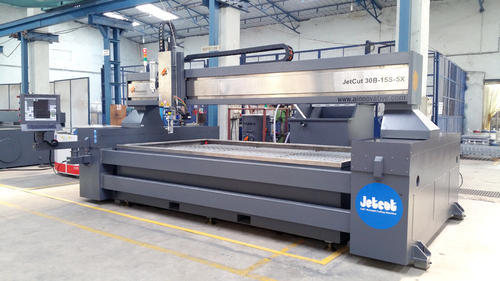
CNC Water Jet Cutting Machine
A CNC waterjet cutting machine uses a high-pressure stream of water, often mixed with abrasive particles, to cut materials. A pump pressurizes water (up to 60–90 kpsi) which passes through a tiny nozzle, focusing it into a jet that can cut virtually any material (metal, stone, glass, composites) without heat damage
The CNC controls the motion of the nozzle over the workpiece.
Type of CNC Water Jet Cutting Machine
Pure Waterjet: Uses only water (for soft materials like foam, rubber).
Abrasive Waterjet (AWJ): Adds garnet or aluminum oxide abrasives for cutting harder materials (metals, ceramics). AWJ is standard for industrial cutting.
Pump Type: Intensifier pump (oil-driven piston) vs. direct-drive pump (crankshaft). Intensifiers are common in large machines.
Axes: 2D cutting tables vs. 3–5 axis (tilting head) for angled cuts.
Application in Various Industries
Waterjets are used in metal fabrication, aerospace, automotive, stone cutting, composites, and metalworking. They are ideal for cutting thick metals (steel up to several inches) and exotic materials (titanium, Inconel) because no heat-affected zone is produced. Also used for architectural stone and glass. In India and globally, waterjets are chosen where precision and material variety are needed (e.g. custom metal parts, sculptures, specialty components).
Material Selection Considerations
High-pressure components use titanium or stainless steel valves and housings to withstand pressure. The orifice is often ruby or diamond to resist wear. Mixing tubes (where water meets abrasive) are ceramic or tungsten carbide to resist erosion. Feed water must be ultra-filtered to avoid nozzle clogging. After cutting, abrasives remain (work area must handle slurry). Tables have abrasive-resistant liners. Safety enclosures (steel or strong acrylic) keep the jet contained.
Everything you need to know about cnc water jet cutting machine
With Water Jet Cutting Machines having versatility in cutting almost any materials, it is used in industries where 5-axis processing is to be done, also it has the ability to cut 2D sheets into 3D parts, so it is widely used in the industries like Aerospace & Defence, Automotive Industry, Transportation and Shipping, Fashion & Design, Construction, areas where cutting is in demand like Machine & System Engineering, E; electronics, Public & Educational Centres, Power & Energy, Biotech & Medical, Gaskets & Seals.
It is also used in industries where flexibility in cutting to cut a wide range of different parts of the same parent material. Multi-head beams use for several cutting heads which are mounted for multiple production capacities.
Best deals of Water Jet Cutting Machine manufacturers, dealers, suppliers in India, Available on Indian TradeBird which suits you best for your requirements at competitive rates.
Water Jet Cutting Machines are effectively used in many industries to cut any type of materials be it soft or hard, it can cut plastic, rubber, wood, foam, glass, stones, metals, and other composites. It is widely used in many industries as it provides smooth cutting edges with the precision of 0.1 mm to any materials, also it has no negative heat effects with no micro cracks or stress, it can provide high precision cuts on any materials, it is easy to operate with requiring no special skills and another maintenance cost it is seen to be economical as well.
Water Jet Cutting Machine is connected with an Ultra High-Pressure Pump which is filtered and pressurized then delivering via high-pressure tubes which are at the head of the machine. A small-diameter orifice connecting the water beam and the pressure turns into velocity. Also to increase the cutting power, abrasive grains are added to the stream and the water beam turning into high-speed liquid sandpaper which increases its efficiency to cut all types of materials be it soft or hard. It is also most viable for really narrow components.