
HOTLINE: +91 851-114-2701
1 listings from verified sellers across India
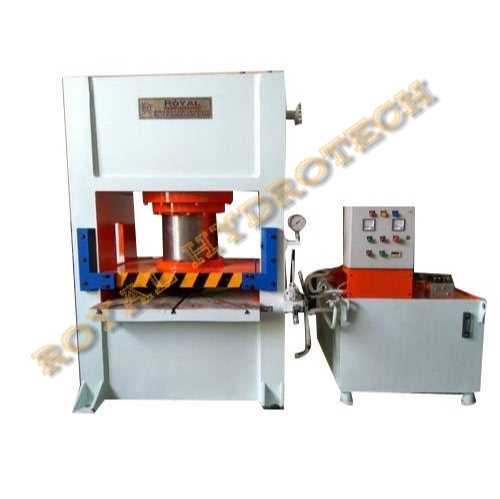
Hydraulic Press
A hydraulic press is a machine that uses the Pascal's principle to generate large compressive forces. It consists of two interconnected cylinders of different cross-sectional areas filled with an incompressible fluid. A small force applied to the smaller piston creates pressure that is transmitted equally throughout the fluid, resulting in a much larger force on the larger piston. This makes them ideal for tasks requiring high force.
Types Hydraulic Press
C-Frame (Gap Frame) Presses: Open on three sides, offering easy access to the working area. Suitable for smaller parts and applications requiring frequent loading/unloading.
H-Frame (Four-Column) Presses: Provide greater rigidity and uniform pressure distribution, ideal for larger parts, deep drawing, and stamping operations.
Straight-Side Presses: Offer maximum rigidity and precision, often used for high-tonnage applications and progressive die stamping.
Benchtop Presses: Smaller, often manually operated or low-tonnage presses for laboratory or light industrial use.
Arbor Presses: Simple, manually operated presses, often used for pressing bearings or small assembly tasks.
Forging Presses: Heavy-duty presses designed for hot or cold forging applications.
Baling Presses: Used to compress materials like scrap metal, paper, or textiles into dense bales.
Applications in Various Industries
Manufacturing:
Forming & Deep Drawing: Shaping sheet metal into complex forms (e.g., automotive body panels, kitchen sinks).
Stamping & Punching: Cutting and perforating materials.
Forging: Shaping metals by compressive forces, either hot or cold.
Bending: Bending metal sheets or plates.
Assembly: Press-fitting bearings, bushings, and other components.
Waste Management: Baling waste materials (paper, plastics, metal scrap) for recycling or disposal.
Powder Compaction: Compacting powders into desired shapes in industries like ceramics, pharmaceuticals, and powder metallurgy.
Rubber & Plastics: Compression molding of rubber and plastic products.
Food Industry: Forming certain food products, pressing oils.
Technology:
Relies on a hydraulic system comprising a pump, hydraulic fluid, cylinders (ram and cylinder), valves, and controls. Modern presses incorporate advanced PLC (Programmable Logic Controller) systems for precise control of pressure, speed, stroke, and dwell time, often with safety interlocks and force monitoring.
Material Selection Considerations