
HOTLINE: +91 851-114-2701
1 listings from verified sellers across India
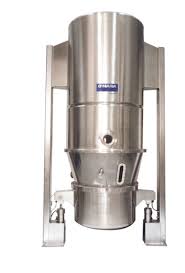
Fluid Bed Dryer
A fluid bed dryer dries particulate materials by fluidizing them in a stream of hot air. The feed solid (powders, granules, pellets) is placed on a perforated bed, and heated air is blown upward. When air velocity is high enough, particles behave like a fluid (“fluidized” state)
This maximizes contact with hot air, enabling rapid evaporation of moisture. The apparatus typically consists of a steel chamber with a perforated plate, a hot air furnace/blower, and cyclone or filter to capture fines.
Type of Fluid Bed Dryer
Fluid bed dryers are classified by agitation method. A conventional fluid bed has a flat perforated bed and uses airflow alone to fluidize material
A vibrating fluid bed adds mechanical vibration to handle sticky or poorly flowing materials
An agitated (or stirred) bed includes mechanical agitators or paddles within the bed to mix material while fluidizing
Other variants include bottom-spray or top-spray granulating bed dryers, which can simultaneously dry and granulate or coat particles. Systems differ in scale from lab to large production beds, and may include temperature/humidity controls and in-line filters.
Applications in Various Industries
Fluid bed drying is used in pharmaceuticals (drying granules after wet granulation), fine chemicals, food processing (drying grains, spices, instant coffee), and minerals. For example, in pharma it’s used for drying tablets granules or pellet coating. In food, fluid beds can dry tea leaves, cereals, or powdered ingredients. In chemicals, salts or catalysts are dried in fluid beds. This method is prized for uniform drying and gentle handling.
Material Selection Considerations
Dryers must handle heated air and potentially corrosive materials. Pharmaceutical/food-grade units are constructed of stainless steel (316L) for sanitary use. A mild-steel or carbon-steel version (often painted) is used for bulk chemicals. The perforated plate (bed) is often stainless or powder-coated steel; filler filters use stainless wire mesh. For heat sources, coils or burners may be steel or alloy. All wetted parts (if any spraying) are stainless. Material selection prioritizes corrosion resistance and cleanability; plastics are generally not used due to high temperatures.
Everything you need to know about fluid bed dryers
Advantages of Fluid Bed Dryer are 1. It has low operating costs, it has accurate control of the residence time, the product is dried uniformly, it has low energy consumption compared to other types of dryers, it has a small footprint, it is a reliable system, with less downtime, it is even gentle on sensitive materials.
A typical fluidized bed dryer consists of the following components, A. Exhaust filter, B. Exhaust blower, C. Air preparatory unit, D. Product container, E. Spray nozzle, F. Solution deliver, G. Air distribution plate, H. Control panel.
Fluid Bed Dryers operate on the theory of fluidization, which is the transformation of a substance from a static solid to a dynamic fluid. Hot gas or air is injected into the material-holding area via a perforated distribution plate in this process.