
HOTLINE: +91 851-114-2701
1 listings from verified sellers across India
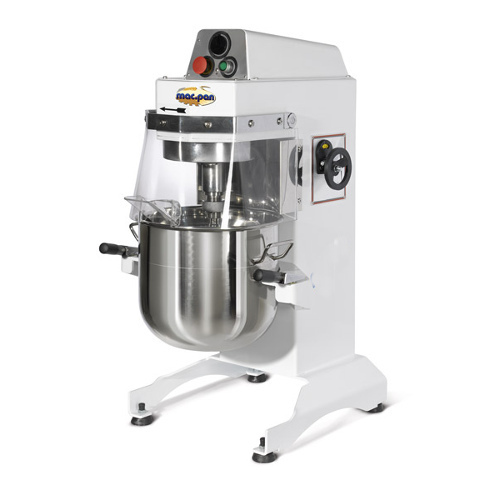
Planetary Mixer
A planetary mixer is a mixing machine where one or more agitator blades rotate about a central axis (the “sun”) while simultaneously orbiting around that central axis (like planets). Typically it has two blades: one scrapes the sides of the mixing vessel and the other disperses the material. This dual motion produces intensive mixing, stirring, and shear, making planetary mixers ideal for highly viscous or thixotropic materials.
Type of Planetary Mixer
Planetary mixers come in batch and continuous modes. Batch mixers are loaded, mixed, and then emptied for the next batch; continuous models have an inlet for material and an outlet, allowing uninterrupted operation. They vary by mounting style: top-entry (agitator enters from above the tank), bottom-entry, side-entry, or in-line mixers (integrated into piping). Sizes range from small laboratory units to large industrial tanks. Materials of construction are chosen by application; for example, mixers for food, cosmetics, or pharmaceuticals use stainless steel (food-grade 304/316) for the bowl and blades to meet hygiene standards, whereas industrial mixers for adhesives or construction materials might use painted carbon steel or alloy steel surfaces.
Applications in Various Industries
Planetary mixers are used in adhesives, sealants, and coatings (mixing epoxies, mastics), paints and inks, cosmetics and personal care, pharmaceuticals (ointment mixing, granulation), and food products (chocolates, pastes)
They also process ceramics and polymers. In India and abroad, they are favored for small-volume, high-viscosity processing. Mixers may be fitted with heating/cooling jackets, vacuum capabilities, or vacuum de-airing accessories for specialized use.
Material Selection Considerations
For sanitary or reactive materials, wetted parts (bowls, blades, shafts) are usually stainless steel (often 316L) to resist corrosion and simplify cleaning. In less-critical applications (e.g., heavy construction adhesives), lower-cost carbon steel or mild steel (with appropriate coatings) may be used for the vessel, though blades often remain stainless for wear resistance. Gearboxes and shafts are made from alloy steel for strength. Seals and gaskets are selected by chemical compatibility (PTFE, silicone). Overall, components must withstand high torque loads; welds and joints should be robust, and the mixer frame is typically made of structural steel.
Everything you need to know about planetary mixer
Blending is usually a gentle method of combining materials, while mixing is usually a more intense process.
Planetary Mixer is versatile equipment making it useful for home as well as for commercial purposes. It can be widely used for the baking dough, icings, sausages, sauces, meringues, whipped toppings, cakes, cookie dough, etc. They are mainly used for making pizza bread too as its dough is too heavy for mixing, also it has the ability to make artisan bread, bagels, Neapolitan pizza dough, etc.
Planetary mixing action is when an attachment, such as a dough hook or a whip, rotates so many times around the bowl and makes contact with the side of the bowl, ensuring that all ingredients are thoroughly combined and uniformly integrated. Mixers from Kitchen Aid can be used for a lot more than just baking.