
HOTLINE: +91 851-114-2701
1 listings from verified sellers across India
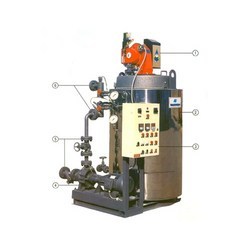
Thermic Fluid Heaters
A thermic fluid heater (also known as a thermal oil heater or hot oil boiler) is an industrial heating system that uses a special heat transfer fluid (thermic fluid or thermal oil) as a medium to transfer heat from a furnace to various process applications. Unlike steam boilers, they operate at much higher temperatures at or near atmospheric pressure, eliminating the need for high-pressure vessels, blowdown, and water treatment.
Types of Thermic Fluid Heater
Solid Fuel Fired Heaters: Use biomass (wood, briquettes, rice husk), coal, or other solid fuels.
Liquid Fuel Fired Heaters: Use fuels like furnace oil, LDO, diesel, or natural gas.
Gas Fired Heaters: Use natural gas, LPG, or biogas.
Electrically Heated Heaters: Use immersion heaters to heat the thermic fluid, often for smaller systems or where precise temperature control is needed.
Vertical Heaters: Space-saving design, often used for smaller to medium capacities.
Horizontal Heaters: Larger capacity, common for industrial applications.
Closed-Loop Systems: Most common, where the thermic fluid continuously circulates.
Applications in Various Industries
Textile Industry: Drying, dyeing, heat setting.
Chemical & Pharmaceutical Industry: Heating reactors, distillation columns, dryers, heat exchangers.
Food & Beverage: Frying, baking, drying, pasteurization, sterilization.
Paper & Pulp Industry: Drying paper, heating calenders.
Rubber & Plastics Industry: Curing, molding, extrusion, laminating, calendering.
Edible Oil Industry: Cooking, refining, deodorizing.
Plywood & Laminate Industry: Hot presses.
Technology:
Involves a coil (typically helical) through which the thermic fluid circulates, absorbing heat from combustion gases (or electric elements). A high-efficiency burner for fuel combustion. An expansion tank to accommodate fluid expansion. A circulation pump to move the fluid. Control systems (PID controllers, PLCs) for temperature regulation, safety interlocks, and alarm systems. The thermic fluid itself is typically a synthetic organic oil or mineral oil with high thermal stability and a high boiling point.
Material Selection Considerations