
HOTLINE: +91 851-114-2701
1 listings from verified sellers across India
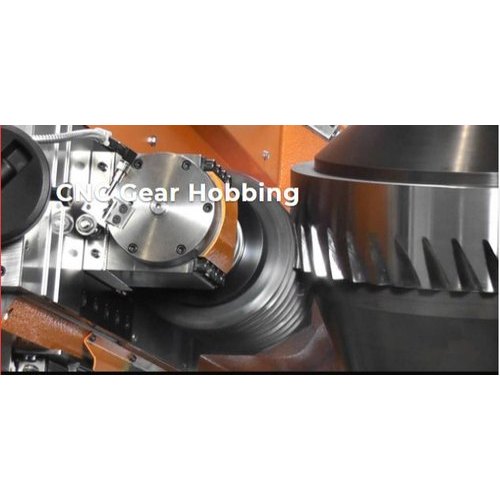
Gear Hobbing Machine
A gear hobbing machine is a specialized machine tool used to generate gears, splines, and sprockets by a continuous, automatic, and highly accurate machining process called hobbing. It employs a rotating, multiple-tooth cutting tool called a "hob" that resembles a worm gear. As the hob and the gear blank rotate synchronously, the hob's cutting teeth progressively remove material from the blank, forming the precise tooth profiles. Hobbing is one of the most productive and versatile methods for manufacturing various gear types.
Types of Gear Hobbing Machine
By Configuration:
Vertical Gear Hobbing Machines: The hob is mounted vertically, and the gear blank is placed on a horizontal worktable. Suitable for larger diameter gears and heavy-duty applications.
Horizontal Gear Hobbing Machines: The hob is mounted horizontally, and the gear blank is held vertically. Typically used for smaller gears and precision applications, offering better access.
By Automation:
Manual Gear Hobbing Machines: Older models requiring manual setup and operation.
CNC Gear Hobbing Machines: Equipped with Computer Numerical Control systems, allowing for precise control of all axes (hob rotation, workpiece rotation, feed rates, hob shift) for complex gear profiles, high accuracy, and automated operation. These are standard in modern manufacturing.
By Application:
General Purpose Hobbers: For a wide range of spur, helical, worm, and bevel gears.
Specialized Hobbers: For specific types like spline hobbing, sprocket hobbing, or hobbing specific types of worm gears.
High-Volume Production Hobbers: Designed for rapid, continuous production of large quantities of gears (e.g., automotive industry).
Applications in Various Industries:
Automotive Industry: Manufacturing transmission gears, differential gears, splines, and shafts. This is a primary user due to high-volume production needs.
Aerospace: Producing high-precision gears for aircraft engines, actuators, and control systems.
Wind Energy: Manufacturing large, heavy-duty gears for wind turbine gearboxes.
Heavy Machinery: Gears for construction equipment, mining machinery, agricultural machinery.
Robotics & Automation: Precision gears for robotic arms, reducers, and other automated systems.
Machine Tool Industry: Gears for other machine tools.
Technology:
Hob Cutter: A precisely ground multi-tooth cutting tool made of high-speed steel (HSS) or carbide. The unique geometry and material allow it to continuously cut gear teeth.
Synchronized Rotation: The core principle involves precise synchronization between the hob's rotation and the workpiece's rotation, driven by highly accurate gear trains or, more commonly, by electronic gearing in CNC machines.
Axial and Radial Feed: The hob moves axially along the workpiece and/or radially into the workpiece to create the desired tooth depth and profile.
Hob Shift: The hob is continuously shifted axially to distribute wear evenly across its cutting edges, extending tool life.
Coolant Systems: High-pressure coolant delivery systems are essential to lubricate the cutting zone, cool the hob and workpiece, and flush away chips.
Automatic Loading/Unloading: In high-volume production, robotic systems or gantry loaders automate the loading and unloading of gear blanks.
In-process Measurement: Some advanced machines integrate probes or sensors for in-process inspection and adaptive control.
Software for Gear Design & Hobbing: CAD/CAM software for designing gear profiles and generating hobbing programs.
Material Selection Considerations: