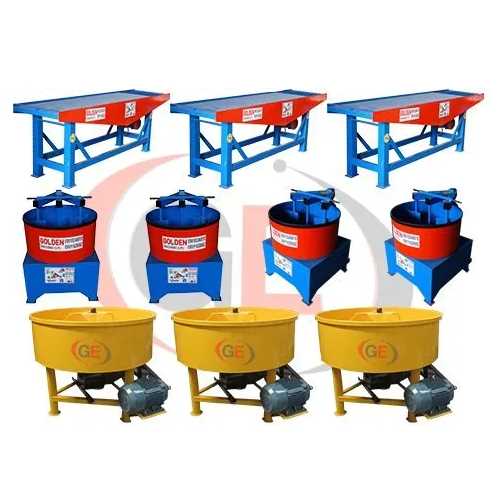
Paving Block Making Machine Manufacturer
A paving block making machine (also called a paver block machine or interlocking block machine) is industrial equipment designed to manufacture concrete paving blocks, kerb stones, and related masonry units used in roads, sidewalks, plazas, driveways and landscaping. These machines compress, vibrate and form a blend of cement, sand, aggregates and sometimes recycled materials into precise moulded units with consistent density and surface finish. Manufacturers supply complete production lines that include batching/mixing, conveying, moulding/pressing, curing and packing systems.
Core functions & purpose
- Precisely dose and mix raw materials (cement, sand, aggregates, pigments, additives).
- Feed and compact material into replaceable moulds using hydraulic or electromechanical pressing combined with vibration for optimal compaction.
- Produce blocks in a variety of shapes and sizes (interlocking, solid, hollow, kerb, cobble) with consistent dimensional accuracy and compressive strength.
- Improve productivity and reduce labor while maintaining uniform quality required for heavy-duty paving applications.
- Enable cost-effective, local production of paving units and support rapid deployment for infrastructure and landscaping projects.
Product types & specifications
- Manual / Semi-automatic machines: Lower capital cost; operator fills moulds and machine provides vibration/compaction. Suitable for small workshops and local supply.
- Fully automatic machines: PLC-controlled batching, automatic mould indexing, hydraulic/electromechanical pressing, automatic stacking/palletizing — high throughput for large manufacturers and exporters.
- Modular lines: Mixed automation — automatic batching and mixing, manual loading or semi-automatic mould systems to balance cost and capacity.
Classification by technology / compaction method
- Hydraulic press machines: High compaction force, suited for heavy-duty blocks and kerbs; robust and durable.
- Electro-mechanical press machines: Precise control, lower maintenance, energy-efficient, good for high-volume production.
- Vibration table systems: Used in conjunction with presses for superior surface finish and compaction for specialized blocks.
Capacity & typical specifications
- Small units: 500–2,000 blocks/day (single-shift); ideal for local contractors.
- Medium units: 2,000–8,000 blocks/day; popular for municipal suppliers and medium-scale manufacturers.
- Large/high-output lines: 8,000–30,000+ blocks/day with continuous automation, used for export-oriented plants and large infrastructure contracts.
Other common specs to evaluate:
- Mould plate size & number of cavities (1/2/4/6 cavities typical)
- Pressing force (kN)
- Cycle time per mould (seconds)
- Mixer capacity (litres)
- Power consumption (kW)
- Machine footprint & weight
Available variants / accessories
- Interlocking block moulds, hollow block moulds, kerb stone moulds, grass block moulds, cobble stone moulds.
- Automatic brick stacking/palletizing, curing chambers (steam or ambient), vibrating conveyors, dosing and weighing systems, pallet trucks.
- Optional pigment dispensers, tile finishers, adjustable compaction settings and remote PLC & HMI interfaces.
Applications & use cases
- Municipal infrastructure: Pavements, footpaths, bicycle lanes, public plazas, bus bays.
- Construction & real estate: Driveways, parking areas, apartment complex landscaping, industrial yard surfacing.
- Landscape & urban design: Garden paths, decorative plazas using coloured or patterned pavers.
- Commercial & industrial yards: Heavy-duty interlocking blocks for container yards, truck terminals.
- Export markets: Supply to countries with growing urbanization and road-building needs.
Common usage scenarios
- Rapid on-site production for a township or housing project to reduce transport costs.
- Factory-based production for standardised pavers supplied to contractors and retailers.
- Production of permeable/porous pavers for stormwater management (SUDS and green infrastructure).
- Use of recycled aggregates or industrial by-products (fly ash, slag) for eco-friendly pavers.
Benefits & efficiencies
- Cost-efficiency: Lower per-unit production cost compared to handcrafted blocks; reduced labor and wastage.
- Consistency & quality control: Uniform compressive strength and dimensional accuracy — important for load-bearing pavement.
- Scalability: Easy to scale production by adding moulds, additional mixers or upgrading to higher automation.
- Sustainability: Machines can use industrial by-products and recycled aggregates, reducing virgin resource demand.
- Speed: High-cycle machines significantly shorten project timelines for large paving contracts.
Manufacturing & industry data
Globally and within major manufacturing countries, paving block machine production tends to cluster where metal-fabrication, foundries and construction-equipment ecosystems exist. Typical strong regions include industrial clusters with engineering supply-chains and access to raw materials, skilled labor and export logistics. In many countries the notable hubs are large industrial cities and states with machine-tool capacity and concrete-products demand.
Types of companies involved
- Large OEMs: Design and build full automatic production lines, export-oriented, offer turn-key plants and project engineering.
- Medium builders: Produce semi-automatic and specialized machines with localized support.
- Local fabricators/engineering workshops: Offer bespoke machines, spare parts and retrofits, often cost-competitive for regional buyers.
- After-sales & service providers: Supply spare moulds, consumables, maintenance, operator training and process optimization services.
Export & market notes
Producers frequently export to neighbouring countries and regions with growing infrastructure needs — including the Middle East, Africa, Southeast Asia and parts of Latin America. Competitive factors in export markets include product durability, energy efficiency, spare-parts availability and financing/support for plant commissioning.
We have the best deals for Paving Block Making Machine at Indian Trade Bird. We are the leading manufacturer, supplier and exporter of Paving Block Making Machine like Mild Steel Paver Block Making Machine, Mild Steel Paving Block Making Machine, Concrete Paving Block Making Machine, Block Making Machine and many more Paving Block making machines are available. High Density the machines are manufactured from high grade steel alloy and have a production capacity of 40-50 strokes per hour. Pressing Capacity- 75 To 100 Tons. Motor- 5 Hp 3 Phase 1440 Rpm per stroke. Total Weight- 2.5 Tons (Approx). The Paving Block Making Machine manufactured is assembled from the top quality component and advanced technology. Our Paving Block Making Machines are highly demanded in the market due to their optimum efficiency, utility, and durability. Our Paving Block Making Machines are of superior quality and are highly appreciated by our clients owing to its low maintenance and rugged construction.
Popular Search
Paving Block Making Machine | Paving Block Making Machine Price | Hydraulic Paver Block Making Machine | Fully Automatic Paver Block Machine Price In Ghaziabad | Paving Block Making Machine Price In Ghaziabad | Manual Paver Block Machine Price | Paver Block Automatic Machine Price | Paver Block Making Machine Price In Ghaziabad