
HOTLINE: +91 851-114-2701
1 listings from verified sellers across India
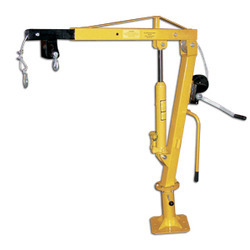
Industrial Cranes
Industrial cranes are heavy machinery designed to lift and move extremely heavy loads, often vertically and horizontally, within a confined area or across a larger workspace. They are indispensable in construction, manufacturing, logistics, and shipbuilding, enabling the movement of materials that would be impossible or unsafe to handle manually.
Types of Industrial cranes
Overhead Cranes (Bridge Cranes):
Consist of parallel runways with a traveling bridge spanning the gap. Hoist (lifting mechanism) moves along the bridge.
Single Girder/Double Girder: Refers to the number of horizontal beams.
Top Running/Under Running: How the bridge travels on the runway.
Gantry Cranes:
Similar to overhead cranes but supported by freestanding legs that run on rails, often on the ground.
Full Gantry: Both legs on ground rails.
Semi-Gantry: One leg on a ground rail, the other on an elevated runway.
Jib Cranes:
Feature a horizontal arm (jib) extending from a fixed vertical mast or wall. Used for localized lifting within a circular or semi-circular area.
Wall-Mounted Jib: Attached to a building column.
Floor-Mounted Jib: Freestanding.
Mobile Cranes:
Mounted on wheels or tracks, offering flexibility and mobility.
Truck-Mounted Cranes: Mounted on a commercial truck chassis for road travel.
Crawler Cranes: Mounted on tracks, excellent for rough terrain and heavy loads, but less mobile.
Rough Terrain Cranes: Designed for off-road use with large tires.
All-Terrain Cranes: Combine features of truck-mounted and rough terrain, suitable for both on-road and off-road.
Carry Deck Cranes: Compact, versatile, and maneuverable with a flat deck for material transport.
Tower Cranes:
Tall, fixed structures used for constructing high-rise buildings, capable of reaching great heights and lifting heavy materials.
Loader Cranes (Knuckleboom Cranes):
Hydraulically powered articulated arms mounted on trucks, used for loading and unloading materials.
Stacker Cranes:
Automated cranes used in warehouses for efficient material handling and storage.
Telescopic Cranes:
Feature a telescoping boom that extends and retracts, offering versatility in reach.
Applications in Various Industries
Construction: Lifting and placing concrete, steel beams, pre-fabricated sections, and construction materials (tower cranes, mobile cranes).
Manufacturing: Moving raw materials, work-in-progress, and finished goods within factories (overhead cranes, jib cranes, gantry cranes).
Shipbuilding: Lifting large components for ship assembly (heavy-duty gantry cranes, floating cranes).
Logistics & Warehousing: Loading/unloading trucks, stacking goods, managing inventory (gantry cranes, stacker cranes, forklift-mounted cranes).
Ports & Docks: Loading and unloading cargo from ships (port cranes, container cranes).
Mining & Quarrying: Moving excavated materials and heavy machinery.
Energy Sector: Installation and maintenance of power plant components, wind turbines.
Material Selection Considerations
Structural Components (Girders, Booms, Legs, Masts):
Wire Ropes/Cables:
Sheaves and Drums:
Gearboxes and Bearings:
Hooks:
Wheels/Tracks:
Hydraulic Cylinders and Components:
Electrical Components: Copper for wiring, various plastics and metals for enclosures and control panels.