
HOTLINE: +91 851-114-2701
1 listings from verified sellers across India
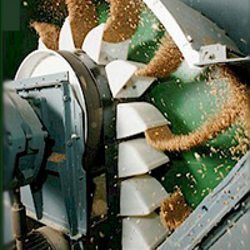
Bucket Elevator
A bucket elevator is a vertical conveyor for bulk materials. It consists of a series of buckets attached to a continuous belt or chain loop. As the belt/chain circulates, each bucket scoops up material at the bottom, carries it vertically, and then discharges it at the top by centrifugal force or gravity. This effectively lifts free-flowing bulk solids to higher elevations. Bucket elevators are widely used in material handling and “often used to raise free-flowing bulk solid materials to a higher elevation”.
Type of Bucket Elevator
There are several common types of bucket elevators:
Centrifugal Discharge (High-Speed): Buckets are lifted at high speed to the head pulley; upon passing over the pulley, the rotation throws the material out. Best for granular, free-flowing materials (grains, seeds).
Continuous Discharge (Low-Speed): Buckets move slower, and at the top they invert or tip to unload by gravity into a chute. Suited for fragile or sticky materials (pellets, powders).
Belt-Driven vs Chain-Driven: Most small/medium elevators use a belt with buckets bonded or bolted on. Heavy-duty elevators use a steel chain for attaching buckets (higher strength for heavy loads).
Incline vs Vertical: Although mainly vertical, some designs allow inclined transport (bucket flights with deeper pockets) but those are still often classified as “elevators” when angle is steep.
Applications in Various Industries
Bucket elevators are used to move bulk solids:
Agriculture and Grain Handling: Elevating grain, feed, and seeds into silos, bins, or hoppers. Grain elevators on farms or terminals typically use large centrifugal bucket elevators.
Food Processing: Moving rice, sugar, flour, or other food grains between floors or processing steps. (Buckets and frames may be stainless steel in food use.)
Mining and Mineral Processing: Lifting ores, coal, sand, and aggregates from lower to higher stages of processing. Chain-driven elevators are common here for heavy tonnage.
Chemical and Pharmaceutical: Handling granular chemicals or powders (salt, fertilizers, plastic resins). Clean-in-place designs may be used for sanitary materials.
Wastewater and Recycling: Conveying dewatered sludge pellets or recyclables (e.g. crushed glass).
Material Selection Considerations
Bucket elevators must resist wear and corrosion: