
HOTLINE: +91 851-114-2701
1 listings from verified sellers across India
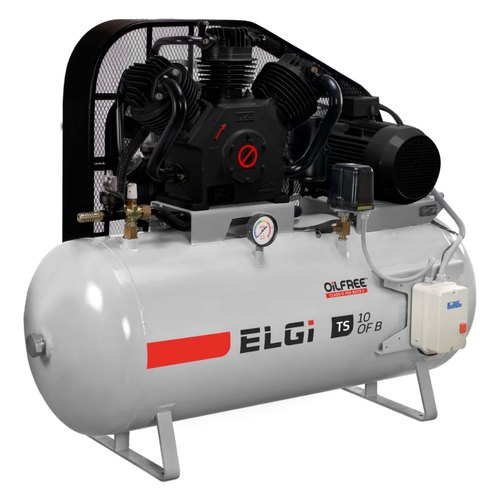
Oil Free Air Compressor
An oil-free air compressor is a type of air compressor that delivers compressed air without any oil coming into contact with the air stream. Unlike lubricated compressors, which use oil for sealing, cooling, and lubrication, oil-free compressors are designed to produce air that is completely free of oil aerosols and vapors, which is critical for applications where air purity is paramount.
Types of Oil Free Air Compressor
Reciprocating Oil-Free Compressors (Piston Compressors):
Use pistons to compress air, but with non-lubricated piston rings (often made of PTFE or carbon composites) and bearings.
Single-Stage/Multi-Stage: For different pressure requirements.
Rotary Screw Oil-Free Compressors:
Use two intermeshing helical rotors to compress air, but without oil injection into the compression chamber. Achieved by precise timing gears that prevent rotor contact and often require external lubrication for the gears and bearings, which are sealed off from the air path.
Dry Rotary Screw: No lubrication in the compression chamber.
Water Injected Screw: Uses water for cooling and lubrication in the compression chamber, which then needs to be separated from the air.
Rotary Scroll Oil-Free Compressors:
Use two spiral-shaped scrolls (one fixed, one orbiting) to trap and compress air. They are inherently oil-free due to the design that prevents metal-to-metal contact between the scrolls. Known for quiet operation and smooth air delivery.
Centrifugal Oil-Free Compressors:
Use impellers rotating at high speeds to accelerate air, converting kinetic energy into pressure. Inherently oil-free because there's no contact between the rotating and stationary parts in the compression chamber. Used for very high volumes of air.
Diaphragm Compressors:
Use a flexible diaphragm to compress air, with no contact between the diaphragm and the air, ensuring oil-free output. Often used for laboratory or medical applications.
Applications in Various Industries
Food & Beverage: Packaging, processing, mixing, fermentation, and conveying where compressed air directly contacts food products. (Absolute air purity to prevent contamination).
Pharmaceuticals: Manufacturing processes, tablet coating, sterile packaging, pneumatic conveying of ingredients. (Strict purity requirements to prevent contamination).
Electronics Manufacturing: Cleanroom environments, assembly of sensitive components, precise tool operation. (Prevents contamination of sensitive electronics).
Medical & Dental: Dental drills, ventilators, medical gas supply, laboratory equipment. (Air purity is critical for patient safety and precise operation).
Textile Industry: Air jet looms, yarn production, pneumatic controls. (Prevents oil stains on fabrics).
Chemical Industry: Applications where oil contamination could react with chemicals or compromise product purity.
Paint & Surface Coating: Spray painting, powder coating. (Prevents oil contamination that can lead to paint defects).
Breweries: Fermentation, bottling, cleaning.
Material Selection Considerations
Compression Chamber/Casing:
Rotors/Impellers (for Screw/Centrifugal):
Piston Rings (for Reciprocating):
Bearings:
Shafts: Hardened steel or stainless steel.
Seals: PTFE, carbon, or other oil-free, wear-resistant materials.
Piping & Air Lines: Stainless steel or appropriate corrosion-resistant plastics to maintain air purity.