HOTLINE: +91 851-114-2701
2 listings from verified sellers across India

JIB Cranes
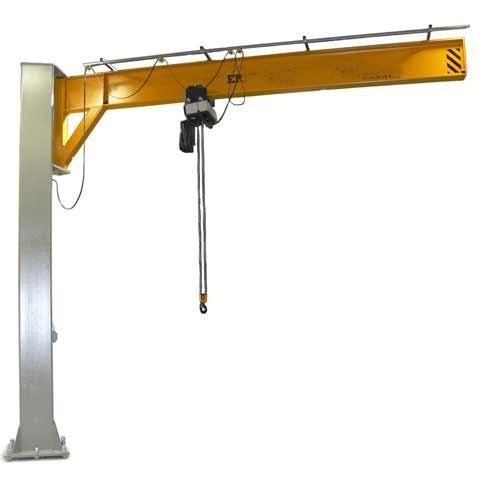
A jib crane is a type of crane that consists of a horizontal member (jib or boom) supporting a movable hoist, which is fixed to a wall or to a floor-mounted pillar. It is used for lifting and moving loads within a limited arc or circular area, providing localized lifting solutions.
Types of JIB Cranes
Wall-Mounted Jib Cranes: Fixed to a wall or building column, saving floor space.
Cantilever Jib Cranes: Jib extends horizontally from the wall.
Tie-Rod Jib Cranes: Jib supported by a tie-rod from above, allowing for a wider span.
Floor-Mounted Jib Cranes (Pillar/Column Jib Cranes): Mounted to the floor with a robust concrete foundation. The jib rotates around a fixed mast.
Mast Type Jib Cranes: Similar to floor-mounted, but the mast itself rotates, often offering larger capacities.
Articulating Jib Cranes: Have multiple hinged arms, allowing the hoist to reach around obstacles or into tight spaces.
Over-Braced vs. Under-Braced Jib Cranes: Refers to how the jib is supported (above or below the boom), affecting head clearance.
Manual/Powered Rotation: Jib can be rotated manually or with an electric motor.
Fixed/Variable Speeds: Hoist and trolley can have fixed or variable speeds.
Applications in Various Industries
Manufacturing & Assembly Lines: Used for lifting and positioning components at workstations, loading/unloading machine tools, and small-scale material handling.
Warehousing: Spot lifting of goods, loading trucks in specific areas.
Welding & Fabrication Shops: Moving heavy parts for welding, grinding, or assembly.
Docks & Ports: For localized loading/unloading of cargo (though larger cranes are more common).
Maintenance & Repair Shops: Lifting engines, heavy machinery components.
Foundries: Handling molds and castings.
Technology:
Structural Design: Engineered to safely support the maximum rated load, considering bending moments and rotational stresses.
Hoist & Trolley: Typically electric chain hoists or wire rope hoists, with manual or electric trolleys for horizontal movement along the jib.
Rotation Mechanism: Manual rotation, or electric motors with gearboxes for powered rotation.
Braking Systems: For controlling hoist movement and rotation.
Safety Features: Limit switches for lift height and travel, overload protection, emergency stop buttons, and robust foundations.
Material Selection Considerations
Jib/Boom: