
HOTLINE: +91 851-114-2701
1 listings from verified sellers across India
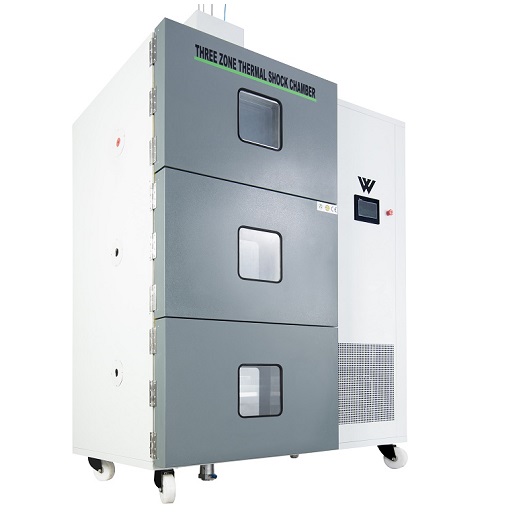
Thermal Shock Chambers Manufacturer In Sonepat
Testing Product Reliability Under Extreme Temperature Transitions
Modern products must withstand sudden and extreme temperature changes without failure. As a trusted Thermal Shock Chambers Manufacturer In Sonepat, we design advanced testing solutions that evaluate product durability when exposed to rapid thermal transitions.
Our thermal shock chambers help manufacturers identify structural weaknesses, material fatigue, and performance risks—long before products reach real-world environments.
What Are Thermal Shock Chambers?
Thermal Shock Chambers are specialized testing systems designed to expose test specimens to abrupt shifts between hot and cold environments. Unlike conventional temperature testing, thermal shock testing focuses on rapid temperature change to evaluate how materials and components respond to extreme thermal stress.
This type of testing is essential for ensuring long-term reliability and safety in critical applications.
Trusted Thermal Shock Chambers Manufacturers for Demanding Applications
As one of the experienced thermal shock chambers manufacturers, we combine precision engineering with robust industrial design. Each chamber is built using high-grade insulation, fast-response thermal systems, and intelligent control technology to achieve rapid temperature transfer with consistent results.
Our chambers meet global testing standards and are suitable for continuous R&D and production testing.
Types of Thermal Shock Chambers We Manufacture
Two-Zone Thermal Shock Chambers
Designed with separate hot and cold zones, allowing rapid transfer of test samples between extreme temperatures.
Three-Zone Thermal Shock Chambers
Featuring independent hot, ambient, and cold zones for precise control and advanced testing flexibility.
Customized Thermal Shock Chambers
Engineered to meet specific temperature ranges, transfer times, chamber sizes, and international testing standards.
Key Features of Our Thermal Shock Chambers
Rapid temperature transition capability
Wide hot & cold temperature ranges
Uniform airflow for consistent exposure
Programmable test cycles & dwell times
Advanced digital controllers with data logging
Rugged construction for long service life
Applications of Thermal Shock Chambers
Our thermal shock chambers are widely used in:
Electronics & semiconductor testing
Automotive & EV component validation
Aerospace & defense applications
Electrical & industrial equipment testing
Research & quality assurance laboratories
Why Choose Us as Your Thermal Shock Chambers Manufacturer?
Proven expertise in thermal stress testing
High accuracy & repeatable test performance
Custom-built solutions for critical applications
Competitive pricing with global quality standards
Strong technical support & after-sales service
Companies searching for reliable thermal shock chambers manufacturers In Sonepat trust us for precision, performance, and durability.
Get the Right Thermal Shock Testing Solution
Looking for a dependable Thermal Shock Chambers Manufacturer to evaluate your product’s resistance to extreme temperature changes?
Contact our experts today to discuss your requirements and receive a solution designed for accurate and repeatable testing.
Top 10 Thermal Shock Chambers | Two-Zone Thermal Shock Chamber | Three-Zone Thermal Shock Chamber | Benchtop Thermal Shock Chamber | Walk-in Thermal Shock Chamber | High-Low Temperature Chamber | Environmental Test Chamber | Temperature Test Chamber | Humidity Test Chamber | Stability Test Chamber | Environmental Simulation Equipment | Thermal Shock Chamber Manufacturers In Sonepat | Thermal Shock Chamber Suppliers | Thermal Shock Chamber Exporters | Industrial Thermal Shock Chamber | Laboratory Thermal Shock Chamber
Everything you need to know about thermal shock chamber
2-zone chambers have hot and cold sections, while 3-zone adds a room temperature section for complex testing.
Industries like electronics, automotive, aerospace, and defense rely on this testing.
It is used to test a product's resistance to sudden and extreme temperature changes.
In Vertical Orientation Thermal Shock Chamber has two independently controlled hot and cold zones, a single product carrier moves between each zone which results in dramatic temperature changes. Also, it has the advantage that it uses fewer floor spaces making it a better deal for smaller labs.
In Horizontal Orientation Thermal Shock Chamber has three side-by-side independent zones hot, ambient & cold. This chamber is used for accomplishing by programing the product carrier which tends to transfer the product from hot to cold and back again, by eliminating dwell in the ambient zone.
A Double Duty Thermal Shock Chamber is positioned in cold zones between two hot zones which are aligned vertically top and bottom. At least one product carrier is always occupied by the cold zone. This design makes efficient use of the chamber cooling system which provides increased product testing over standard thermal shock designs.
The temperature of the chamber is controlled by an electric heater or a refrigeration device. Researchers spray a salt solution through a nozzle within the chamber to mimic the corrosive effect of the sea, for example, creating a fine mist that covers the whole product.
Thermal shock is a form of mechanical load that occurs quickly. A mechanical load is described as a load caused by a rapid change in temperature at a specific point. It can also be applied to a thermal gradient, in which different sections of an object expand at different rates.