
HOTLINE: +91 851-114-2701
1 listings from verified sellers across India
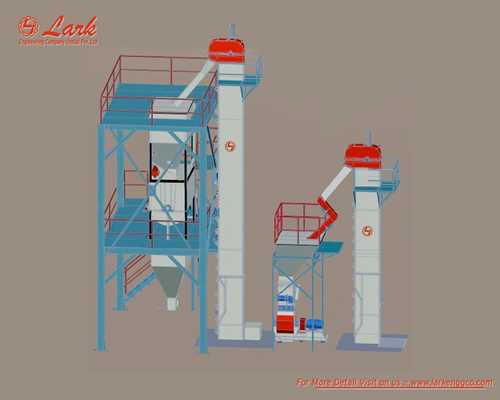
Animal Feed Making Machine
An animal feed making machine is a piece of equipment or a complete system designed to process raw agricultural materials into nutritionally balanced and palatable feed for livestock, poultry, fish, and other animals. These machines typically involve stages such as grinding, mixing, pelletizing, cooling, and packaging, aiming to improve digestibility, nutrient absorption, storage, and ease of handling of animal feed.
Types of Animal Feed Making Machine
Grinders/Mills:
Hammer Mills: Use rotating hammers to pulverize ingredients into fine particles by impact. Versatile for grains, hay, and other fibrous materials.
Roller Mills: Grind grains between two rollers, producing a more uniform particle size and less dust.
Disc Mills: For finer grinding, often used for additives.
Mixers:
Horizontal Ribbon Mixers: Use helical ribbons to blend ingredients. Efficient for large batches and various material types.
Paddle Mixers: Use paddles for gentle but thorough blending, suitable for both dry and wet mixing.
Vertical Mixers: Cone-shaped, use gravity and augers for mixing, space-efficient.
Pellet Mills/Pelletizers:
Ring Die Pellet Mills: High-capacity machines where rollers press feed through holes in a rotating ring die, forming dense pellets. Common for commercial production.
Flat Die Pellet Mills: Simpler design, where rollers press feed through a stationary flat die. Suitable for small to medium scale production.
Conditioners: Steam-heated drums or screws that pre-condition feed before pelletizing, adding moisture and heat for better pellet quality and sterilization.
Coolers:
Counter-current Coolers: Air flows opposite to pellets, efficiently cooling and drying.
Co-current Coolers: Air flows with pellets.
Dryers: For feed requiring specific moisture content reduction, often after pelletizing (e.g., aquafeed).
Crumblers: Break down larger pellets into smaller, crumble-sized feed for young animals (e.g., chicks).
Sifters/Screens: Separate fines and oversized pellets for quality control.
Bagging & Packaging Machines: For filling and sealing bags of finished feed.
Applications in Various Industries:
Poultry Farming: Producing feed for chickens (broilers, layers), ducks, turkeys, ensuring optimal growth and egg production.
Livestock Farming: Feed for cattle, pigs, sheep, goats, horses, customized for different growth stages and nutritional needs.
Aquaculture: Producing specialized floating or sinking feed for fish, shrimp, and other aquatic species.
Pet Food Industry: Manufacturing kibble for dogs and cats.
Feed Mills: Large-scale commercial facilities producing animal feed for distribution.
Individual Farms: Smaller-scale machines for on-farm feed production.
Technology:
Automated Batching & Weighing Systems: Load cells and control systems for precise ingredient measurement and mixing.
Precision Grinding: Optimized mill designs for uniform particle size distribution.
Pelletization: Die and roller designs (e.g., wear-resistant alloys) for durable and consistent pellets.
Steam Injection (Conditioning): For gelatinization of starches and improved pellet quality, also aids in pathogen reduction.
Dust Collection Systems: Integrated cyclones and bag filters to control dust during grinding and mixing.
PLC Control & HMI: Automated control of entire production lines, recipe management, and real-time monitoring.
Magnetic Separators: To remove metallic impurities from raw materials.
Extrusion Technology: For producing specialty feeds like aquafeed (floating pellets) through high-temperature, high-pressure cooking.
Micro-Dosing Systems: For accurately adding vitamins, minerals, and other trace additives.
Material Selection Considerations: