
HOTLINE: +91 851-114-2701
2 listings from verified sellers across India
Pulleys
A pulley is a simple machine used to change the direction of a force or to lift or move heavy loads with less effort. It consists of a wheel with a groove along its edge, through which a rope, cable, or belt can pass. Pulleys are essential components in mechanical systems, especially for applications requiring movement or lifting of objects. By using a pulley, it is possible to lift heavy objects more easily by reducing the amount of force required to move them, making it a vital tool in industries ranging from construction to manufacturing.
Pulleys come in a variety of configurations depending on the needs of the specific application. They are often used in combination with other machines to create mechanical advantage, offering a practical solution to everyday lifting tasks in both industrial and commercial settings.
Types of Pulleys
Fixed Pulley
A fixed pulley has its axle or shaft attached to a stationary object. It does not move with the load, but it changes the direction of the force applied. The load moves up or down, while the force required to lift the load remains the same as the force applied to the rope. Fixed pulleys are often used in simple systems where only a change in direction is required.
Movable Pulley
A movable pulley, unlike the fixed pulley, is attached to the load itself and can move with the load. The advantage of the movable pulley is that it reduces the force needed to lift a load. The load is split between two sections of the rope, making the lifting process easier. Movable pulleys are commonly used in cranes and lifting systems where heavy loads need to be moved with less effort.
Compound Pulley
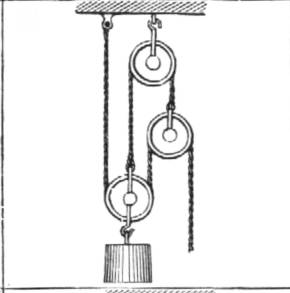
A compound pulley system combines both fixed and movable pulleys to increase the mechanical advantage and reduce the amount of force needed to lift a load. In a compound pulley, both the fixed and movable pulleys work together to create a more efficient system. These systems are used when the lifting task involves heavy or bulky loads, and they are commonly seen in industries like construction, shipping, and mining.
Block and Tackle Pulley
A block and tackle is a type of compound pulley system that uses multiple pulleys arranged in a series to increase the mechanical advantage. This system consists of two blocks, one fixed and one movable, with multiple pulleys within each block. It is used to lift very heavy loads by distributing the force needed across several ropes and pulleys, making it a highly efficient lifting mechanism.
Belt Pulley
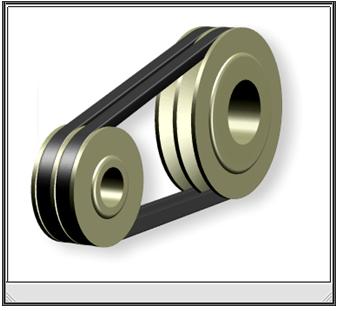
A belt pulley system uses a continuous loop of material (usually rubber or leather) running over pulleys to transfer power from one shaft to another. This type of pulley system is widely used in machinery, such as engines, conveyor systems, and industrial machines, where power needs to be transmitted between two rotating shafts.
Grooved Pulley
Grooved pulleys are specifically designed to hold a belt or rope securely within the grooves along the edge of the pulley. These pulleys ensure that the belt remains aligned during operation and are commonly used in systems where power transmission or continuous motion is required, such as in conveyor belts and other material handling equipment.
Sheave Pulley
A sheave is a type of pulley with a groove around its edge used to guide a rope or cable. Sheave pulleys are often used in lifting systems or for cable-driven mechanisms, where the rope or cable is routed through the groove for efficient operation. Sheaves are designed to handle high loads and are often used in winches and hoisting systems.
Tapered Pulley
Tapered pulleys have a conical shape and are used primarily in belt drive systems where the belt tension needs to be adjusted. The tapered design allows for a tighter fit and better grip between the pulley and the belt, improving the efficiency and stability of the system. These pulleys are used in industries such as automotive and heavy machinery.
Jockey Pulley
A jockey pulley is a smaller pulley used in conveyor systems to maintain the tension of the belt. It adjusts the slack in the belt to prevent it from becoming too loose or too tight, ensuring smooth operation. Jockey pulleys are typically found in large material handling systems or conveyor belt installations.
Capstan Pulley
A capstan pulley is a large, heavy-duty pulley used for moving or pulling heavy loads over a distance. These pulleys are often used in applications where the load must be moved over a long distance, such as in docks, shipping, or cable installation systems.
Applications in Various Industries
Construction and Engineering
Pulleys are commonly used in construction sites for lifting heavy materials like concrete blocks, steel beams, and machinery. They help increase efficiency and reduce labour costs by allowing heavy lifting tasks to be accomplished with minimal human effort. Compound and block-and-tackle pulley systems are particularly prevalent in construction for their ability to move large and heavy loads.
Shipping and Cargo Handling
In the shipping industry, pulleys are used in loading and unloading cargo, especially in ports and docks. The block and tackle pulley system is essential for lifting and moving heavy containers, allowing cranes to efficiently lift goods from ships onto trucks or loading docks.
Manufacturing and Textile Industries
Pulley systems are integral in the textile industry for driving machinery such as spinning wheels, looms, and sewing machines. Pulleys transfer power from motors to various textile machines, ensuring smooth operation and production efficiency. In manufacturing plants, pulleys are also used for moving materials along conveyor belts.
Mining and Quarrying
Pulleys play a significant role in the mining industry, where they are used in winching and hoisting systems for lifting heavy equipment and mined materials. In underground mining operations, pulleys are used to pull ore from deep mines to the surface, as well as to move mining equipment and workers.
Automotive Industry
The automotive industry uses pulleys in engines, transmission systems, and other mechanical components. Belt pulleys are crucial for transferring power between the engine and other components like the alternator, water pump, and air conditioning compressor. They ensure that power is efficiently distributed throughout the vehicle.
Entertainment and Stage Productions
Pulleys are also commonly used in theatre and entertainment, particularly in rigging systems for stage production. Pulleys help to raise and lower stage elements like curtains, lighting rigs, and props, allowing for smooth and quick scene transitions during performances.
Aerospace Industry
In the aerospace industry, pulleys are used in various systems, including control systems for aircraft. They help transfer motion and provide a means of adjusting control surfaces, such as flaps and rudders, in response to the pilot’s commands. Pulleys are also used in landing gear systems and other critical mechanical systems in aircraft.
Power Transmission Systems
In industrial power transmission systems, pulleys are used to transfer rotational energy from one part of the system to another. They are found in generators, compressors, pumps, and other machinery where the transfer of power through belts is required for efficient operation.
Material Selection Considerations